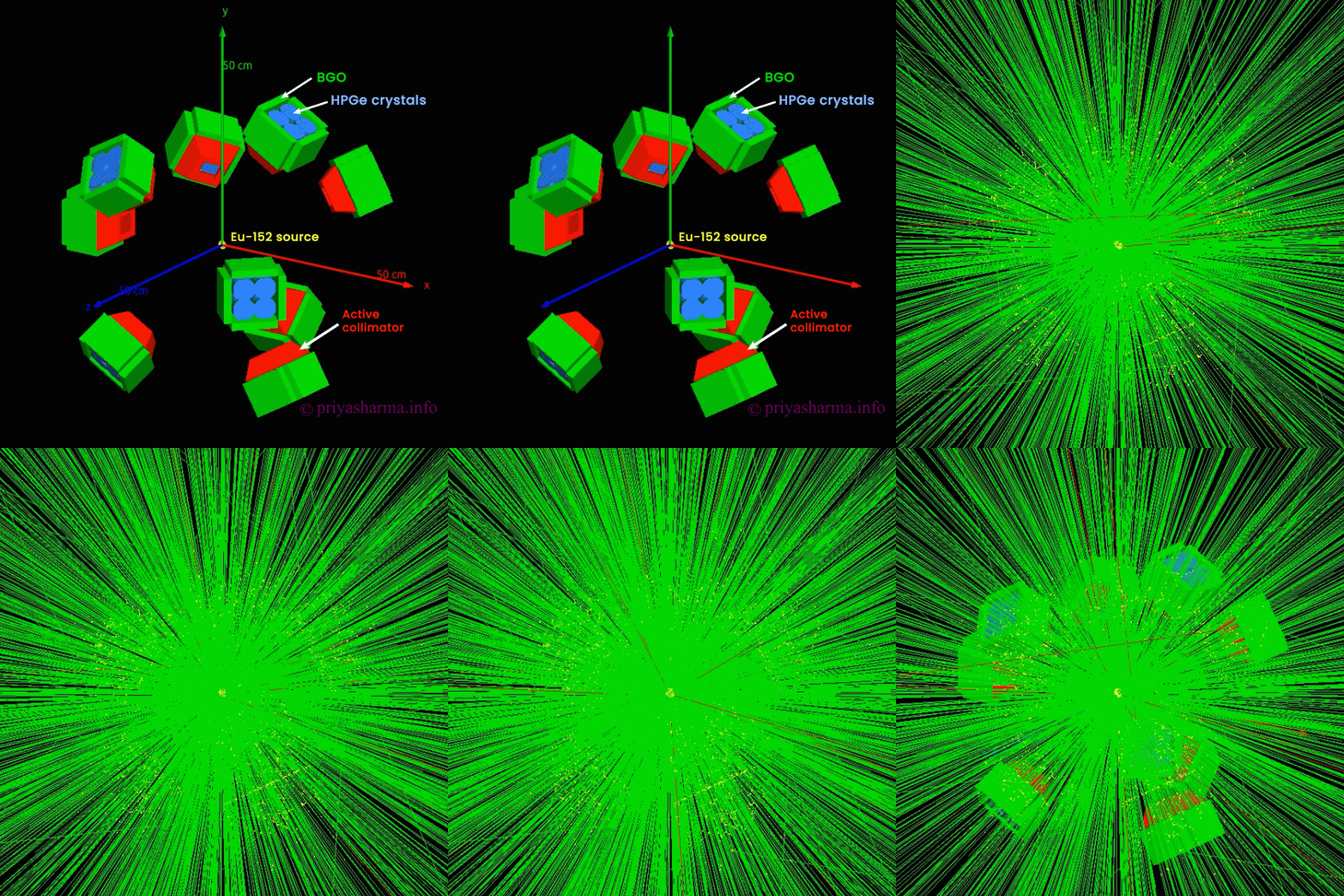
This post presents an educational Geant4 simulation of a hypothetical HPGe clover detector array. It is designed to clearly illustrate key detector-physics concepts in γ-ray spectroscopy: Compton scattering, addback, and anti-Compton background suppression using BGO shields and an active collimator.
The central aim of this study is not geometric sophistication, but spectral quality. In particular, it demonstrates how background arises in γ-ray spectra and how BGO shields combined with veto logic dramatically improve peak-to-background ratio.
1) What is being simulated?
We simulate a compact γ-ray spectroscopy setup based on HPGe clover detectors. Each clover consists of four closely packed HPGe crystals and is positioned around a central γ-ray source.
9 HPGe clover detectors arranged on a sphere (radius ≈ 25 cm)
Each clover containing 4 segmented HPGe crystals
Two detector configurations for direct comparison:
Without BGO shields and active collimator
With BGO shields and an active collimator
A thin disk-like γ-ray source placed at the origin
This simulation is specifically designed to highlight relative background suppression
between different detector configurations.
2) Detector configurations compared
To isolate the role of auxiliary detector systems, we compare two versions of the same
HPGe clover array—identical geometry and source, differing only in background-suppression elements.
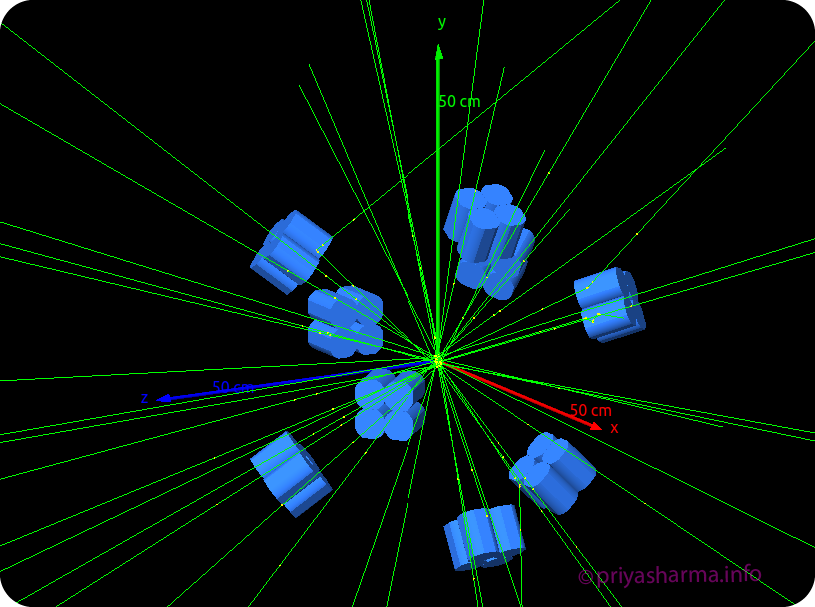
2.1 HPGe clover array without BGO and active collimator
In this configuration, the HPGe crystals are directly exposed to the surrounding space.
Any γ ray that scatters inside a crystal and then escapes is still recorded as a valid event.
No suppression of Compton-scattered γ rays
Large Compton continuum in the energy spectrum
Poor peak-to-background ratio
Figure A. HPGe clover array without BGO shields and active collimator.
Escaping scattered γ rays contribute strongly to background.
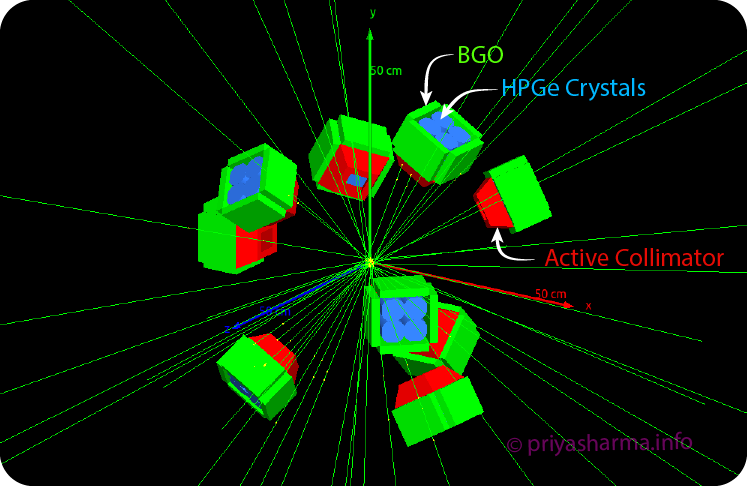
2.2 HPGe clover array with BGO shields and active collimator
In the second configuration, each clover is surrounded by BGO scintillator shields,
and an active collimator is placed in front of the crystals.
BGO detects γ rays that scatter out of HPGe
The active collimator limits acceptance and suppresses off-axis background
Energy deposited in BGO or collimator can be used to generate a veto signal
Figure B. HPGe clover array with BGO anti-Compton shields and an active collimator.
These detectors enable event-by-event background rejection.
3) What is addback and why is it used?
In a segmented detector such as an HPGe clover, a single γ ray frequently deposits energy
in more than one crystal through a sequence of interactions
(e.g. Compton scatter followed by photoelectric absorption).
Addback refers to summing the energies deposited in all four crystals of a clover
within the same event.
Recovers full-energy events shared across crystals
Increases photopeak efficiency
Essential for high-granularity γ-ray detector arrays
Addback alone improves peak efficiency—but it does not suppress background.
For that, veto systems are required.
4) What is veto and how does it work?
The anti-Compton veto is the central concept demonstrated in this simulation.
Event logic:
If a γ ray deposits energy only in HPGe → accept the event
If a γ ray deposits energy in HPGe and in BGO or active collimator → reject the event
Rejected events are overwhelmingly those in which γ rays scatter inside HPGe and escape,
contributing to the Compton continuum.
In this simulation, veto is applied event-by-event using the total energy deposited
in the BGO shields and the active collimator.
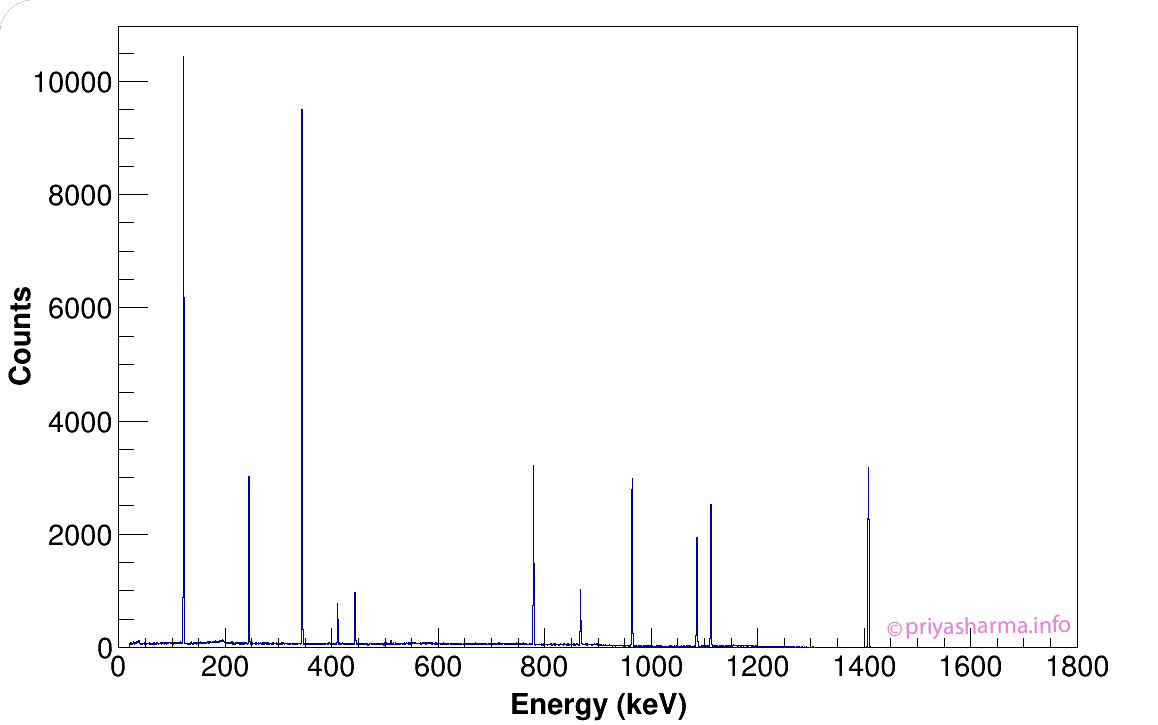
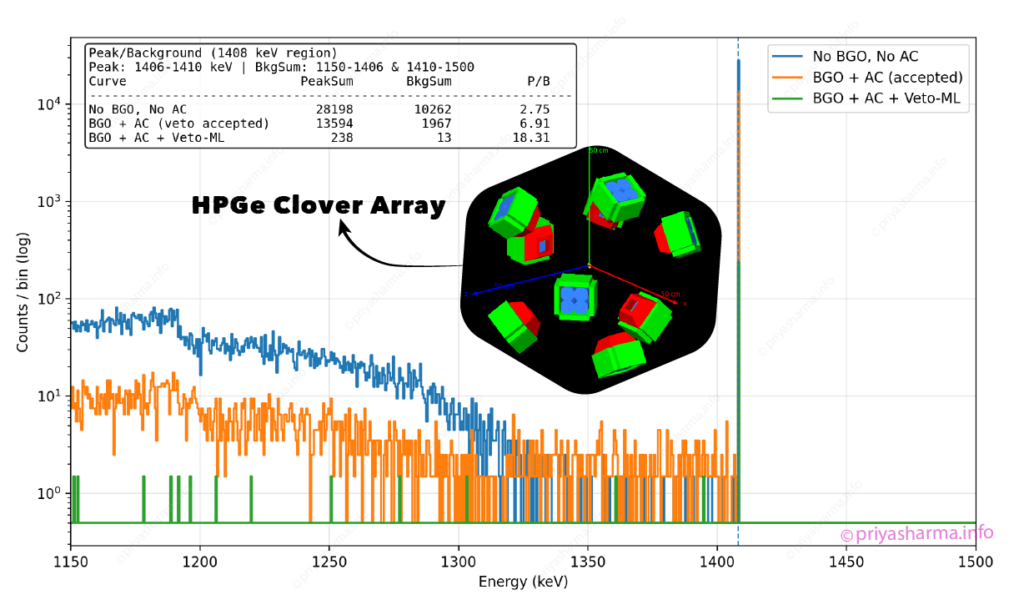
5) Key result: Addback spectrum (sum of all clovers, veto ON)
The figure below shows the addback energy spectrum summed over all clovers,
with BGO and active collimator veto enabled.
Figure C. Addback spectrum (sum of all clovers) with veto ON.
The Compton continuum is strongly suppressed, revealing clean photopeaks.
Strong reduction of low- and mid-energy Compton background
Substantial improvement in peak-to-background ratio
The necessity of anti-Compton systems in precision γ-ray spectroscopy
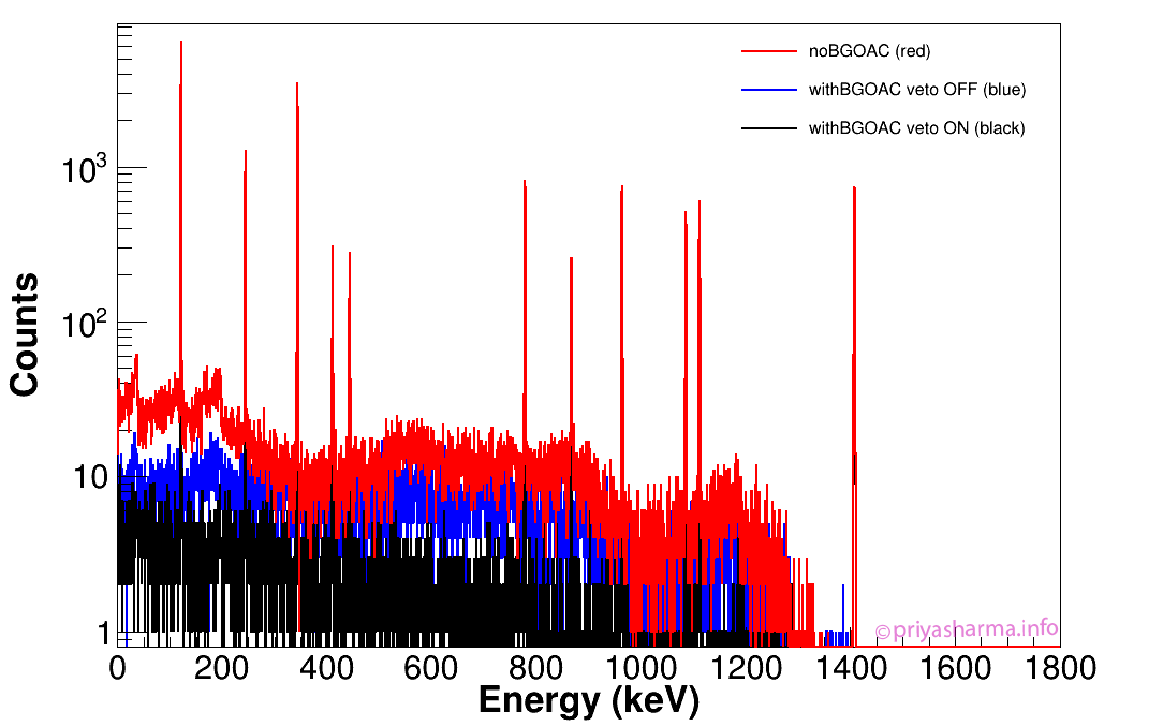
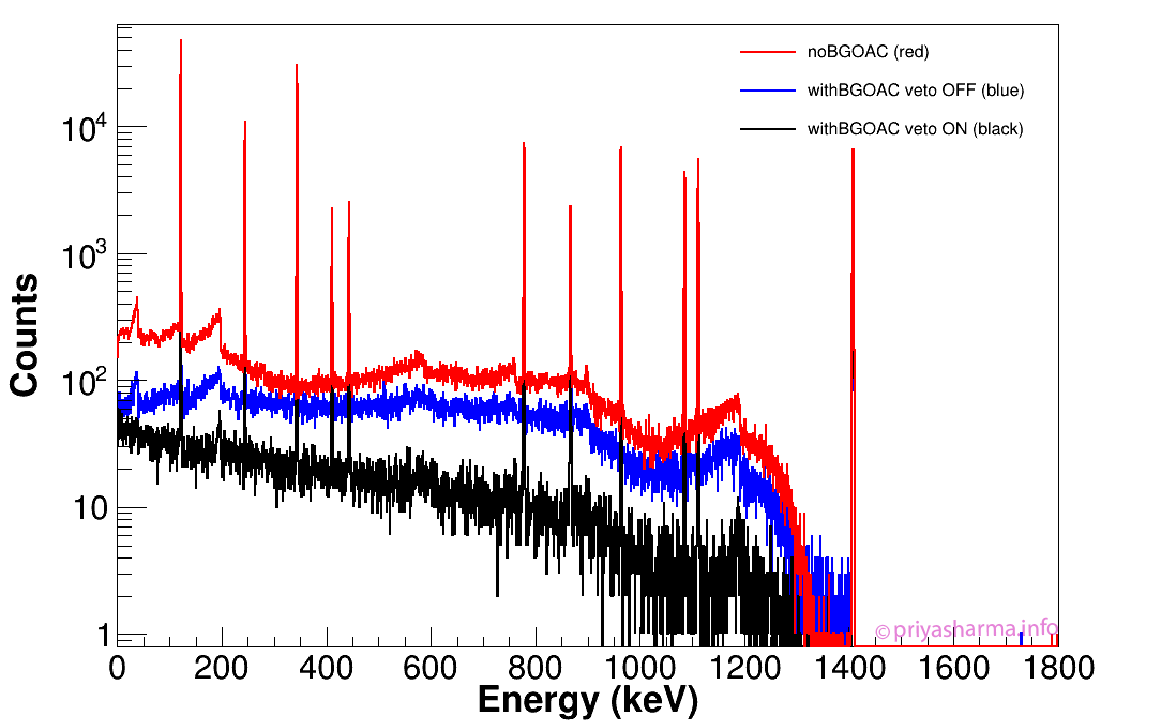
6) Background suppression in practice: log-scale comparison
The most instructive result of this study is not a single photopeak,
but the order-of-magnitude reduction of background across the entire spectrum.
To visualize this clearly, background spectra are plotted on a logarithmic scale.
Why log scale?
γ-ray background spans several orders of magnitude
Linear scale hides low-level Compton contributions
Log scale exposes background behavior at all energies
Three spectra are compared:
Red: no BGO, no active collimator
Blue: BGO + AC present, veto OFF
Black: BGO + AC with veto ON
6.1 Single-clover background (Clover 00)
Figure D. Log-scale addback spectrum for Clover 00.
Red: Dominant Compton background from escaping γ rays
Blue: Partial reduction due to passive absorption
Black: True anti-Compton suppression via veto logic
Key lesson: Energy resolution alone cannot suppress Compton background.
Active detection of escaping γ rays is essential.
6.2 Full-array background (sum of all clovers)
Figure E. Log-scale addback spectrum summed over all clovers.
Background accumulates rapidly without suppression
Veto becomes increasingly critical as detector multiplicity increases
Clean spectra require both addback and veto
7) Why BGO shields and active collimators are essential
These results illustrate a fundamental principle of γ-ray spectroscopy:
Excellent energy resolution is necessary—but background suppression is decisive.
HPGe provides energy resolution
BGO detects escaping γ rays
Active collimators reduce unwanted acceptance
Veto logic removes scattered events
Addback recovers shared full-energy events
Together, addback + BGO + veto define the operating principle
of modern γ-ray detector arrays.
8) What this teaches us
HPGe alone is not enough for clean spectra
Compton background dominates without suppression
BGO acts as a γ-ray escape detector
Veto logic is essential at the analysis level
Addback and veto must be used together
References
G. F. Knoll, Radiation Detection and Measurement, Wiley
K. Debertin & R. Helmer, Gamma- and X-Ray Spectrometry