Blog

Why Anti-Compton Shields Matter: A Geant4 Study of HPGe Clover Spectroscopy

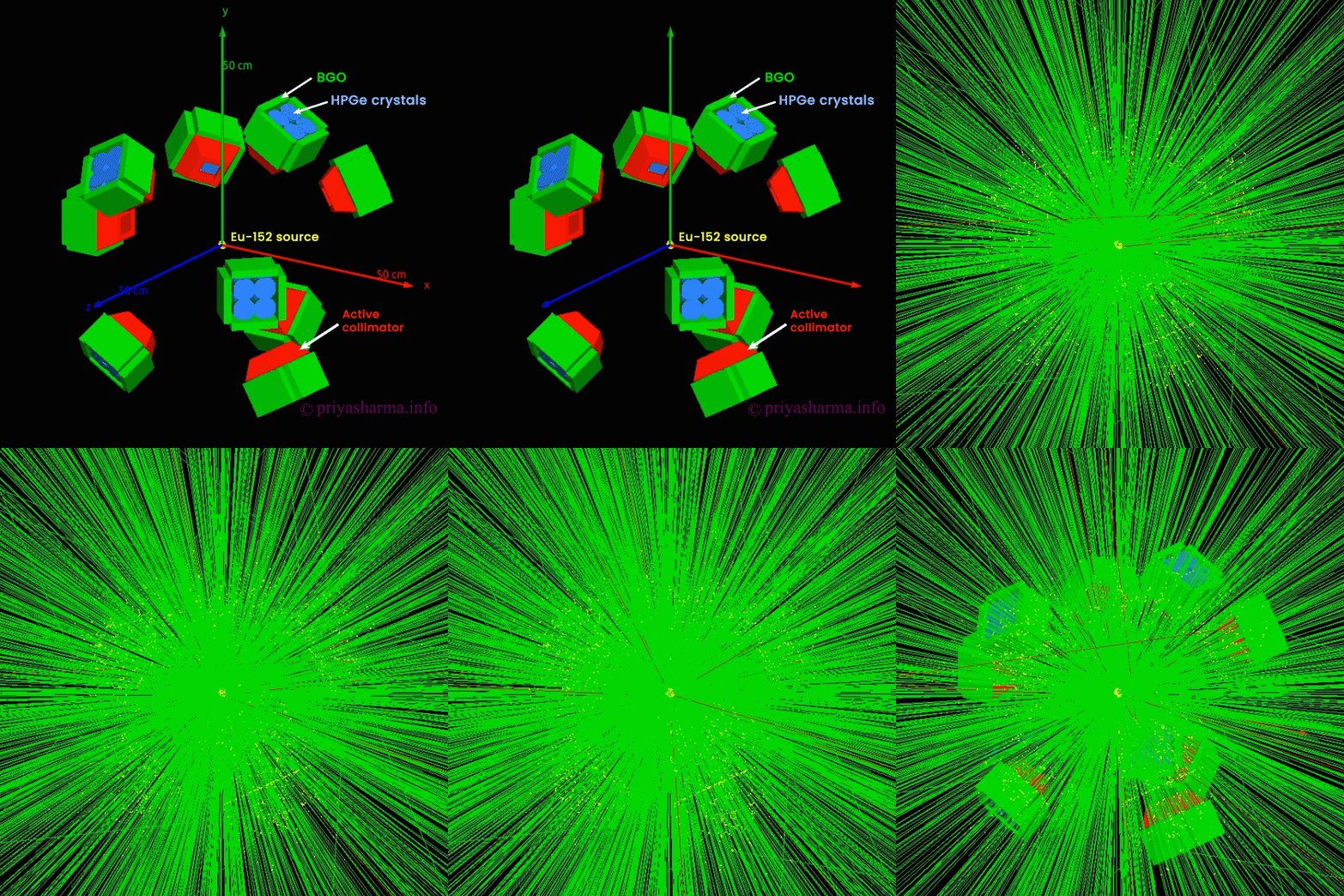
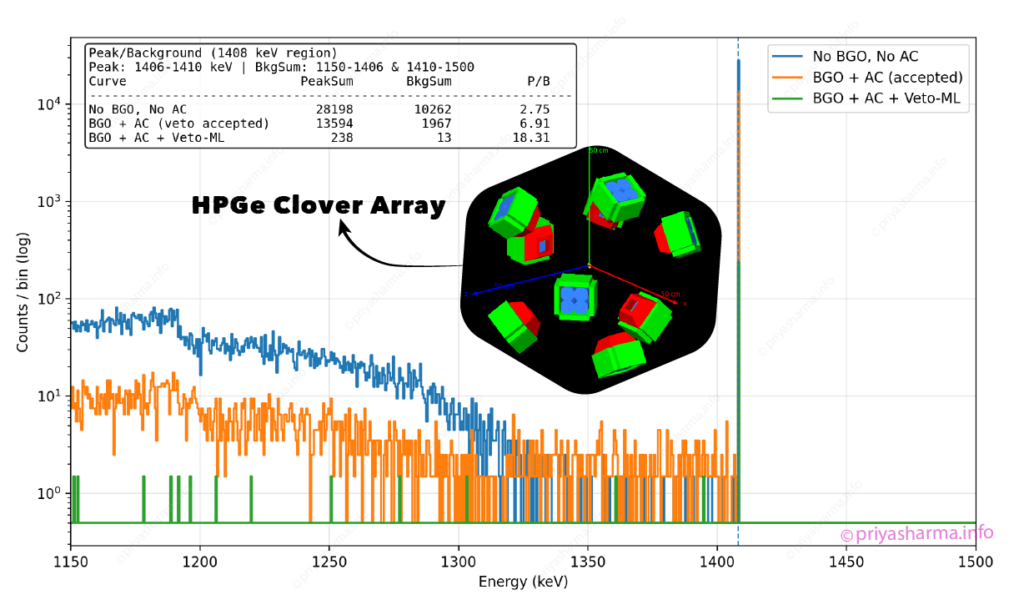
This post presents an educational Geant4 simulation of a hypothetical HPGe clover detector array. It is designed to clearly illustrate key detector-physics concepts in γ-ray spectroscopy: Compton scattering, addback, and anti-Compton background suppression using BGO shields and an active collimator. The central aim of this study is not geometric sophistication, but spectral quality. In particular, […]

Why Anti-Compton Shields Matter: A Geant4 Study of HPGe Clover Spectroscopy Read More »

Building and Visualizing 2D Histograms in CERN ROOT (TH2F)

In the previous tutorials, you learned how to create 1D histograms and perform Gaussian fits using PyROOT.Now we move one step ahead and explore 2D histograms, which are extremely useful in physicsfor visualizing correlations between two variables — for example: Energy vs Time X vs Y detector positions Two correlated detector signals Calibration maps In

Building and Visualizing 2D Histograms in CERN ROOT (TH2F) Read More »

CERN ROOT – Data Analysis Framework for Nuclear and High-Energy Physics

CERN ROOT is an open-source, object-oriented data analysis framework developed at theEuropean Organization for Nuclear Research (CERN).It is designed to handle the large and complex datasets produced innuclear physics andhigh-energy particle physics experiments.ROOT provides an integrated environment for data storage, processing, statistical analysis,visualization, and simulation, making it one of the most widely used tools in

CERN ROOT – Data Analysis Framework for Nuclear and High-Energy Physics Read More »

Mass–Energy Equivalence

According to mass-energy equivalence, all objects having mass have corresponding intrinsic energy, even when they are stationary. The “mass-energy equivalence” principle states that the mass of a system and its energy are the same property in any physical system. This means that anything having mass has an equivalent amount of energy and vice versa. According

Mass–Energy Equivalence Read More »

Scroll to Top