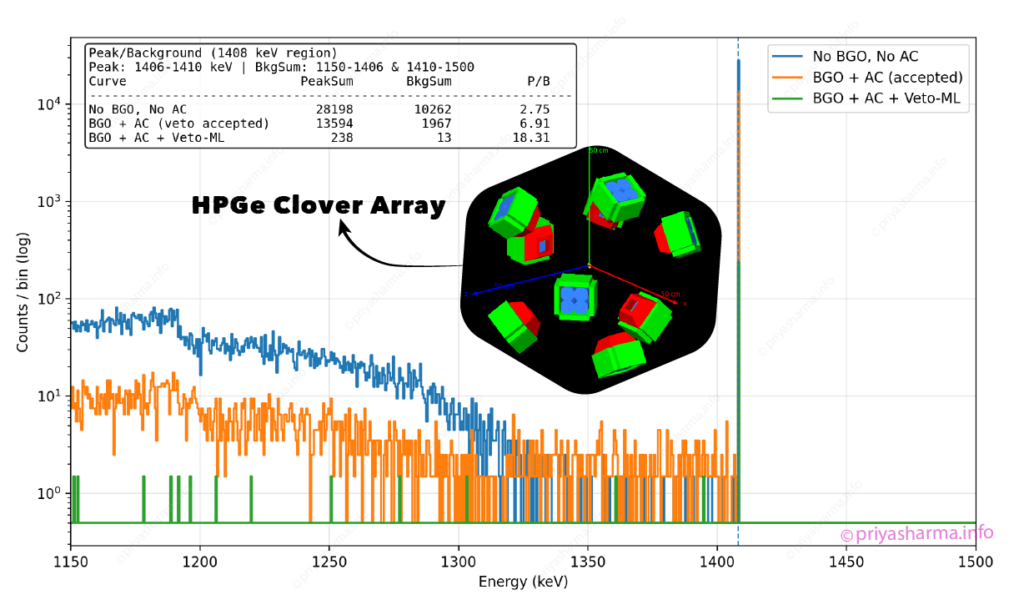
This post continues my earlier Clover-array article: “Why Anti-Compton Shields Matter: A Geant4 Study of HPGe Clover Spectroscopy” . In that study, BGO anti-Compton shielding (and an active collimator) strongly reduced Compton background and improved peak visibility.
Here I ask the next question: can we still improve peak-to-background ratio even after using BGO + active collimation? I show that the answer can be yes, using a veto-trained ML “virtual veto” that learns event topology from the HPGe Clover itself.
1) Why hardware anti-Compton is powerful — and why it is not perfect
The anti-Compton principle is simple: if a gamma ray Compton-scatters in HPGe and the escaped photon deposits energy in BGO, the BGO coincidence tags the event as background-like and it is vetoed. This removes a large part of the Compton continuum and helps reveal weak lines.
Why some background can survive even with BGO + AC
- Geometry/coverage: scattered photons may escape through gaps and miss BGO/AC.
- Threshold/efficiency: BGO energy may be below veto threshold.
- Timing effects: coincidences can be lost due to window, pile-up, or dead time.
This means the “accepted” spectrum after hardware veto can still contain residual Compton-like events. The goal of ML is to identify those residual events using HPGe-only information.
2) What I trained: a peak-independent “virtual veto”
In real experiments, we do not know all gamma lines in advance. Therefore, training an ML model “around a single peak energy” is not practical for general spectroscopy. Instead, I trained ML to reproduce the veto decision:
Training target:
accepted = 1 if the event passes hardware veto (e.g. veto==0),
accepted = 0 if the event is vetoed.
This makes the model energy-agnostic: it learns event physics (Compton-like vs photopeak-like topologies), not specific energies.
3) What features are used for ML — and why
The model uses only HPGe Clover internal event topology (and does not use BGO signals as inputs), because we want the ML to generalize and avoid “cheating” by directly reading the veto system.
HPGe-only inputs (per event)
- Segment/crystal energy deposits:
edep0..edep35(energy-sharing pattern inside clover) - Total energy: sum of deposits (overall scale)
- Multiplicity: number of active segments/crystals (multi-site vs single-site)
- Max deposit / concentration: photopeaks tend to be more localized than Compton chains
Physics intuition:
Full-energy photopeak events are often compact in HPGe (single-site or nearly single-site), while
Compton background typically spreads energy across multiple crystals/segments and is more likely to imply escape.
ML learns this topology and assigns an “accepted-like” score.
4) What I compare (3 curves)
To make the comparison clean, I plot:
- No BGO, No AC (raw clover spectrum)
- BGO + AC (veto accepted) (hardware suppression)
- BGO + AC + Veto-ML (hardware + ML topology filtering)
Note on the full-spectrum ML curve: I display it as an ML-weighted spectrum using the ML score as a weight. This avoids “empty gaps” between peaks while still suppressing Compton-like events smoothly across the spectrum.
5) Result A: full Eu-152 spectrum (log scale)
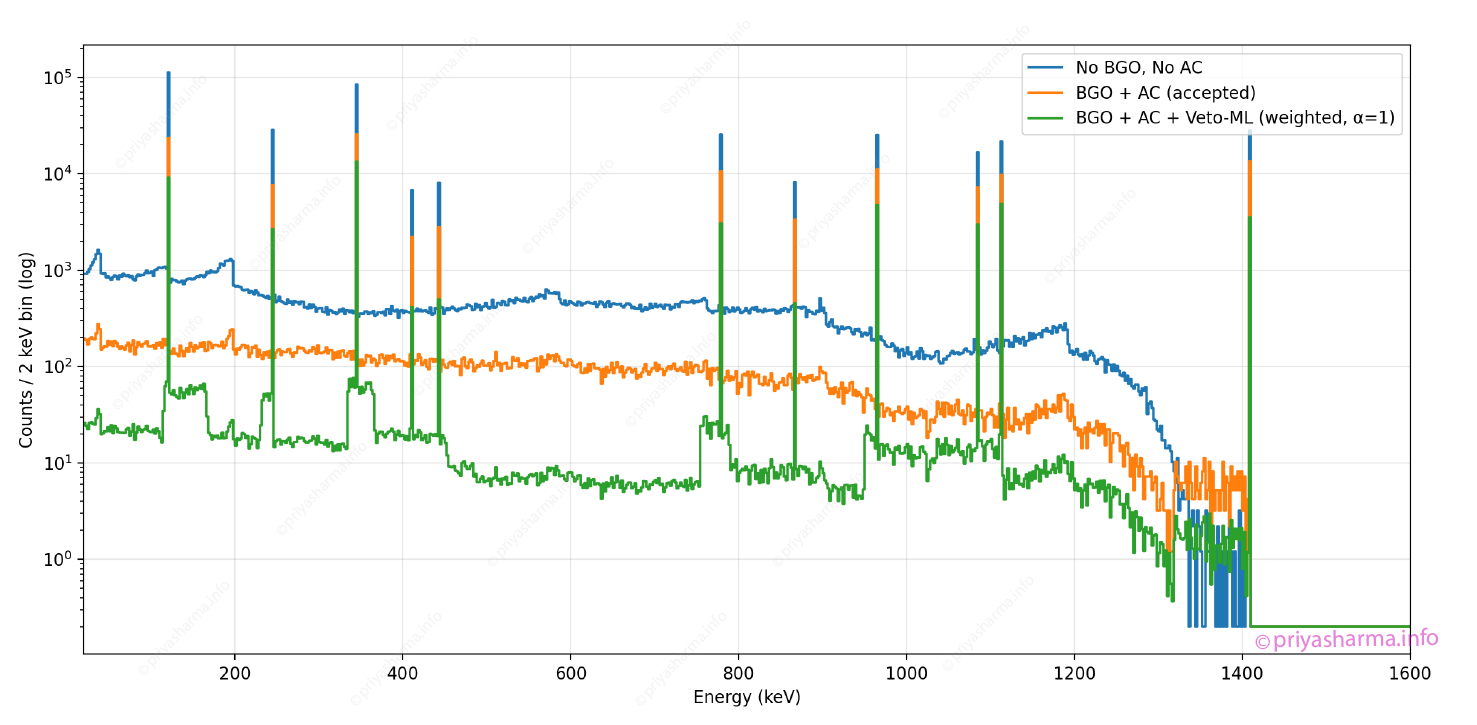
The full-spectrum plot is best for seeing how the continuum behaves globally. For a quantitative conclusion, we zoom around a specific line and compute peak-to-background.
6) Result B: 1408 keV region with Peak/Background table
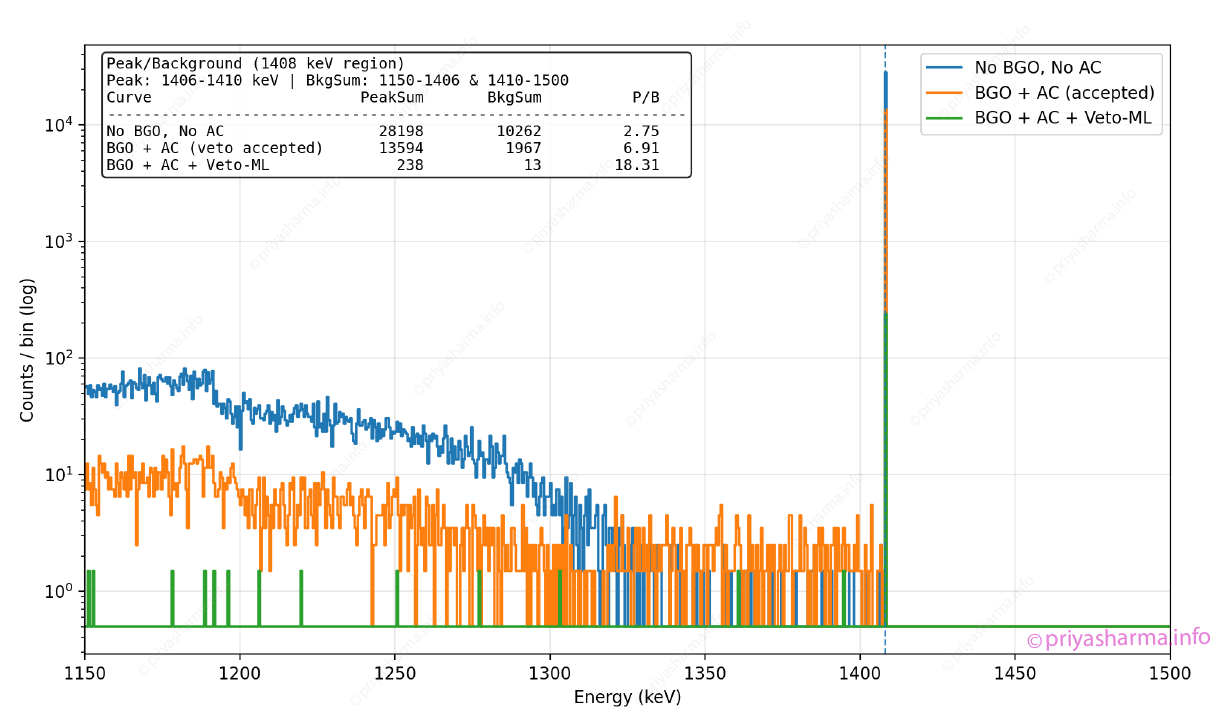
PeakSum (1406–1410 keV) and BkgSum (sidebands 1150–1406 and 1410–1500).
Hardware veto improves P/B, and ML further improves P/B by rejecting residual Compton-like topologies that survived hardware veto.
Interpretation
- No BGO: large Compton background → smaller P/B.
- BGO + AC: strong suppression of escape-Compton events → higher P/B.
- BGO + AC + Veto-ML: additional topology-based cleaning → even higher P/B.
7) Why P/B can improve even after BGO + AC
Hardware veto catches events with an explicit BGO/AC coincidence. But if a scattered photon escapes through an uncovered direction, deposits too little in BGO, or is missed due to timing, the event can remain in the accepted spectrum.
Veto-trained ML helps because it uses HPGe-only event topology to identify those residual Compton-like events. This is why the ML stage can further increase peak-to-background even when BGO + AC is already applied.
In one line: Hardware veto uses external coincidence (BGO/AC), while ML uses internal topology (HPGe segmentation). Combining both gives the cleanest spectrum.
8) What about Peak/Total?
Peak/Total can decrease after veto/ML because both methods can reject some true peak events (e.g., cascades, accidental coincidences) while also changing the total accepted population. For spectroscopy, the most useful pair of metrics is:
- Peak-to-background (P/B) in a local window
- Peak efficiency (how many peak events remain)
So a decreasing Peak/Total does not automatically mean “bad data” — it reflects a trade-off between efficiency and purity.
9) Take-home message
- BGO anti-Compton shielding is essential for suppressing Compton background (as shown in the previous Clover post).
- Veto-trained ML provides an additional, peak-independent way to suppress residual Compton-like events using HPGe topology.
- This approach is relevant for automated spectroscopy, safeguards, and real-time isotope identification workflows.
Appendix: what the programs did (high-level)
- Read ROOT TTrees using
uprootand extractedtotalE,veto, and ML outputs. - Built spectra with common binning and compared three curves: raw, veto-accepted, veto-accepted+ML.
- Zoomed around 1408 keV and computed
PeakSumandBkgSumto report P/B. - For the full spectrum, used ML-score weighting to keep a continuous spectrum