
For more than half a century, nuclear energy has powered our cities, our industries, and our scientific ambitions. Yet today, as the world looks for cleaner and more sustainable energy, nuclear power faces a fundamental question: How do we make it safer, more efficient, and truly sustainable for the future?
The answer does not begin inside a reactor building. It begins much deeper — inside the atomic nucleus.
The Physics at the Heart of Every Reactor
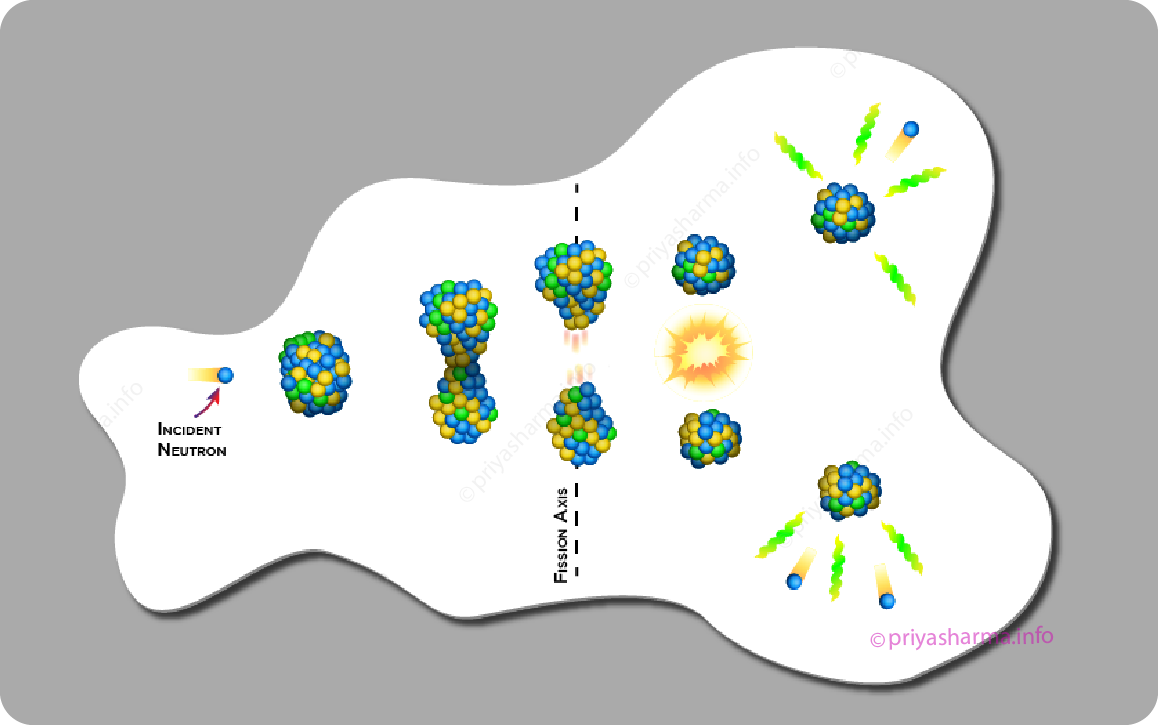
Every nuclear reactor, no matter how advanced its design, is governed by one basic process: nuclear fission. When a heavy nucleus splits, it releases energy, neutrons, and two highly excited fragments. These fragments exist only for a fraction of a second, but what happens during this brief moment determines how a reactor behaves, how efficiently it uses fuel, and how safe it can be.
Why Do We Need Next-Generation Nuclear Reactors?
Uranium, the fuel used in today’s reactors, is a finite resource on Earth. In conventional reactors, we use only a small fraction of its energy potential — more than 90% remains unused. At the same time, current reactors produce nuclear waste containing plutonium and minor actinides, materials that remain radioactive for thousands of years.
Two major challenges
- Limited uranium resources
- Long-lived nuclear waste
How Generation-IV Reactors Address These Challenges
Generation-IV nuclear reactors are designed to address both challenges. These reactors operate with fast neutrons, not thermal neutrons. Fast neutrons allow us to reuse plutonium, burn minor actinides, and extract much more energy from the same amount of uranium. In this approach, what we call nuclear waste becomes a valuable fuel.
Key idea: Fast-neutron systems can turn “waste” into “fuel”, improving sustainability and reducing long-term radiotoxicity.
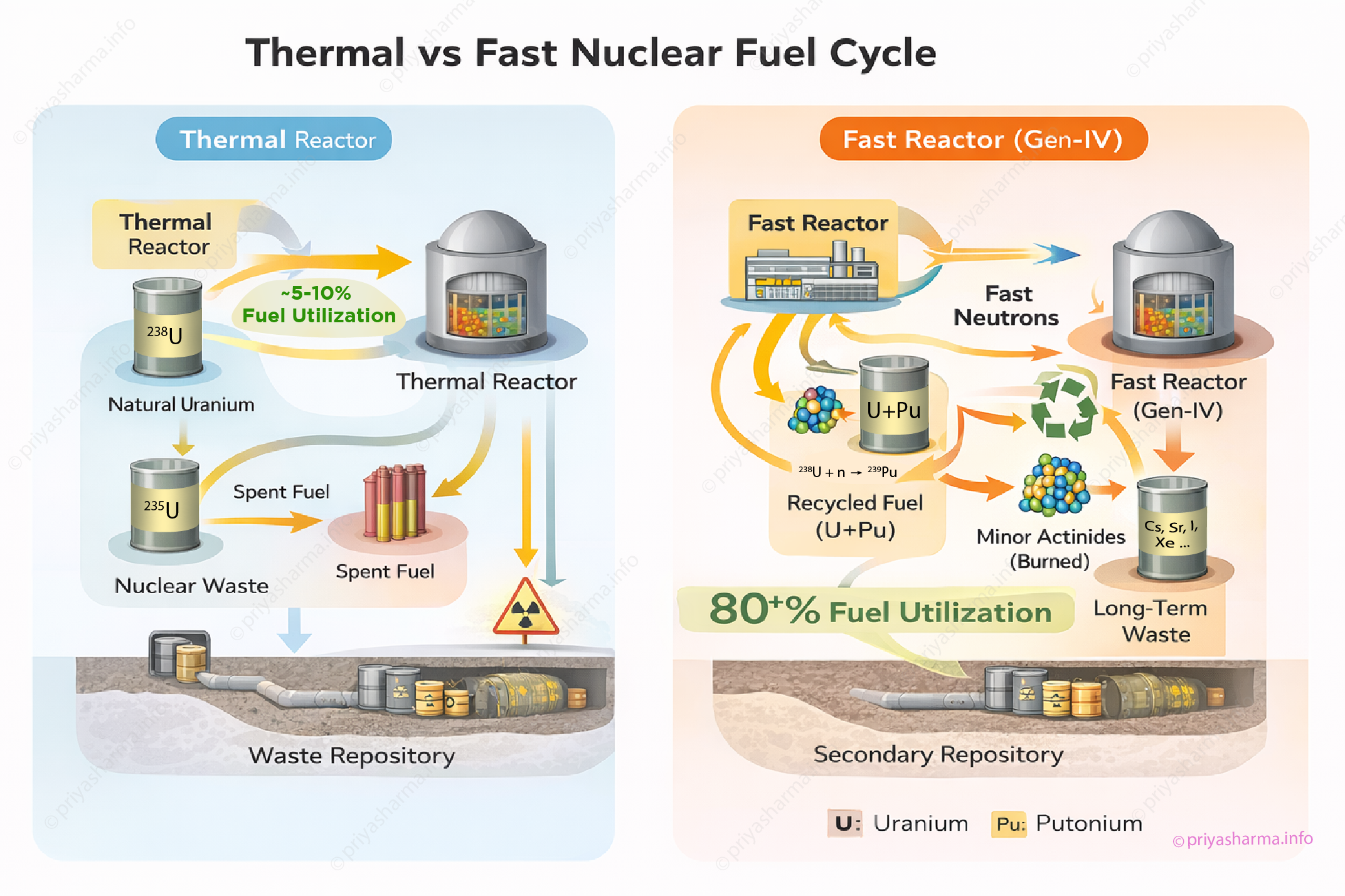
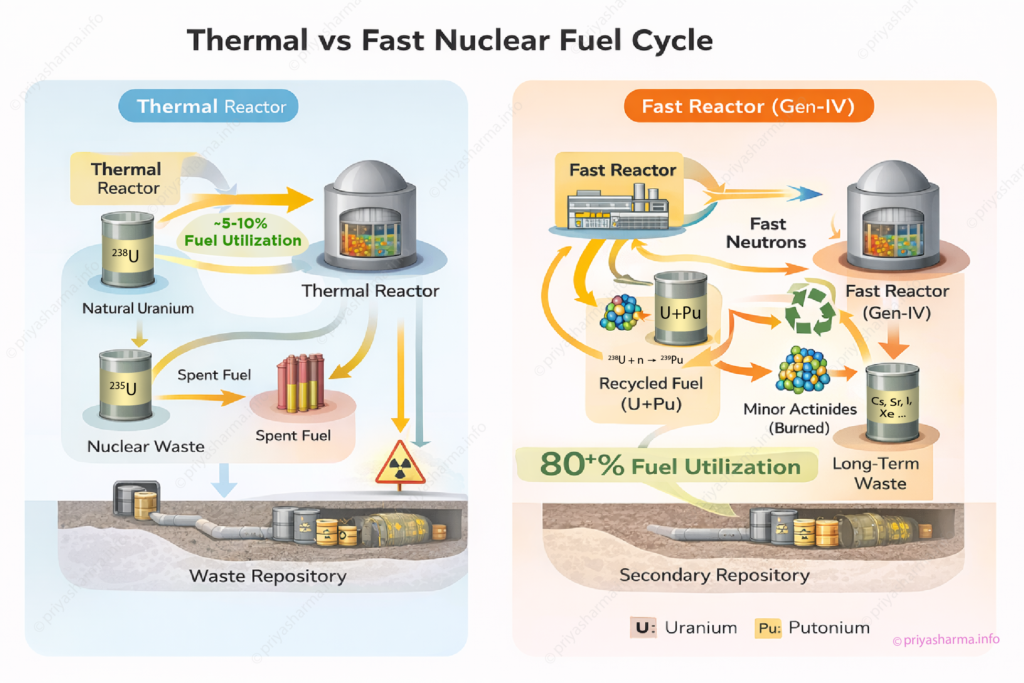
Figure Explanation: Thermal Reactor Fuel Cycle
In a thermal reactor, neutrons are slowed down (moderated) to low energies. This makes fission very efficient for the fissile isotope ²³⁵U, but it does not effectively use the much more abundant isotope ²³⁸U.
What the boxes and labels mean
- Top box: ²³⁸U — This represents the main portion of uranium fuel. In a thermal reactor, ²³⁸U mostly does not fission with slow neutrons, so it remains largely unused.
- Bottom box: ²³⁵U — This is the isotope that actually fissions and produces most of the energy. It is only a small fraction of the fuel.
- “80–90% unused” — This indicates that a large fraction of the heavy material (mainly uranium) leaves the reactor without contributing much energy production.
- Fuel utilization (~10%) — This is a simplified way to show that only a small part of the fuel is effectively used in the once-through (open) thermal fuel cycle.
What happens after irradiation?
After some time in the reactor, the fuel becomes spent fuel. It still contains a lot of uranium (especially ²³⁸U), along with newly formed heavy elements such as plutonium and minor actinides, plus many fission products. In the simplest thermal cycle, this spent fuel is treated as nuclear waste and sent to a waste repository.
Main message of the left side: Thermal reactors produce reliable energy, but they do not fully exploit uranium and they create waste streams that remain radioactive for very long times.
Figure Explanation: Fast Reactor Fuel Cycle (Generation-IV Concept)
In a fast reactor, neutrons are kept at higher energies (fast neutrons). This changes fission behavior and enables a more advanced fuel cycle: plutonium recycling and minor actinide burning. The goal is to extract much more energy from the same original uranium resource.
What the boxes and labels mean
- Top box: “U + Pu” — This represents recycled fuel, a mixture of uranium and plutonium recovered from previously used fuel. In a closed fuel cycle, these valuable materials are not thrown away—they are reused.
- Recycling arrows — The looping arrows show that fuel is processed and returned to the reactor, which is why this is called a closed fuel cycle.
- Minor actinides (burned) — Minor actinides (such as Np, Am, Cm) are among the most problematic long-lived components of nuclear waste. Fast neutrons can fission (or transmute) many of these isotopes, which reduces long-term radiotoxicity.
- “80%+ fuel utilization” — This indicates that fast reactors can potentially extract a much larger fraction of the fuel’s energy content by using both fertile material and recycled plutonium.
What is the “long-term waste” at the bottom right?
Even in an advanced fast-reactor cycle, there will always be waste, because fission produces radioactive fission products. The important difference is that, in an ideal closed cycle, most uranium, plutonium, and even minor actinides are recycled or burned, so the final waste is dominated mainly by fission products and is typically easier to manage.
Main message of the right side: Fast reactors aim to turn “waste” into “fuel” by recycling plutonium and burning minor actinides, dramatically improving sustainability and reducing the long-term waste burden.
The Difference in One View
Thermal reactor (left)
- Uses slow (thermal) neutrons
- Energy mainly from ²³⁵U
- Most ²³⁸U remains unused
- Often an open, once-through cycle → more long-lived waste
Fast reactor (right, Gen-IV)
- Uses fast neutrons
- Can use fertile ²³⁸U to produce fissile plutonium
- Recycles U + Pu fuel (closed cycle)
- Can burn minor actinides → reduces long-term radiotoxicity
- Much higher overall fuel utilization
Why This Matters for Nuclear Data (Link to This Blog’s Main Point)
This figure is not only about reactor engineering — it is fundamentally about physics. When reactors operate with fast neutrons, the fission process changes: fragments are typically more excited, prompt neutron emission increases, and fission fragment mass distributions evolve with neutron energy. That is why new, high-precision fast-neutron fission data—especially post-neutron-emission fission fragment mass distributions—is essential for reliable Generation-IV reactor modelling and safety analysis.
Fast Neutrons Change the Physics of Fission
When fission is induced by fast neutrons, the fragments are more energetic, they emit more neutrons, and their mass distributions change with neutron energy. This means nuclear data measured for older reactors is no longer sufficient.
What changes under fast-neutron fission?
- Fragment kinetic energies increase
- Prompt neutron multiplicity increases
- Mass yields evolve with incident neutron energy
Why Fission Fragment Mass Distributions Matter
One of the most important quantities in this context is the fission fragment mass distribution after neutron emission. Fragment masses directly affect neutron production, energy deposition in fuel, decay heat, and radiation damage in materials. Even small uncertainties can lead to large uncertainties in reactor simulations.
Energy Dependence of Fission Fragment Mass Distributions
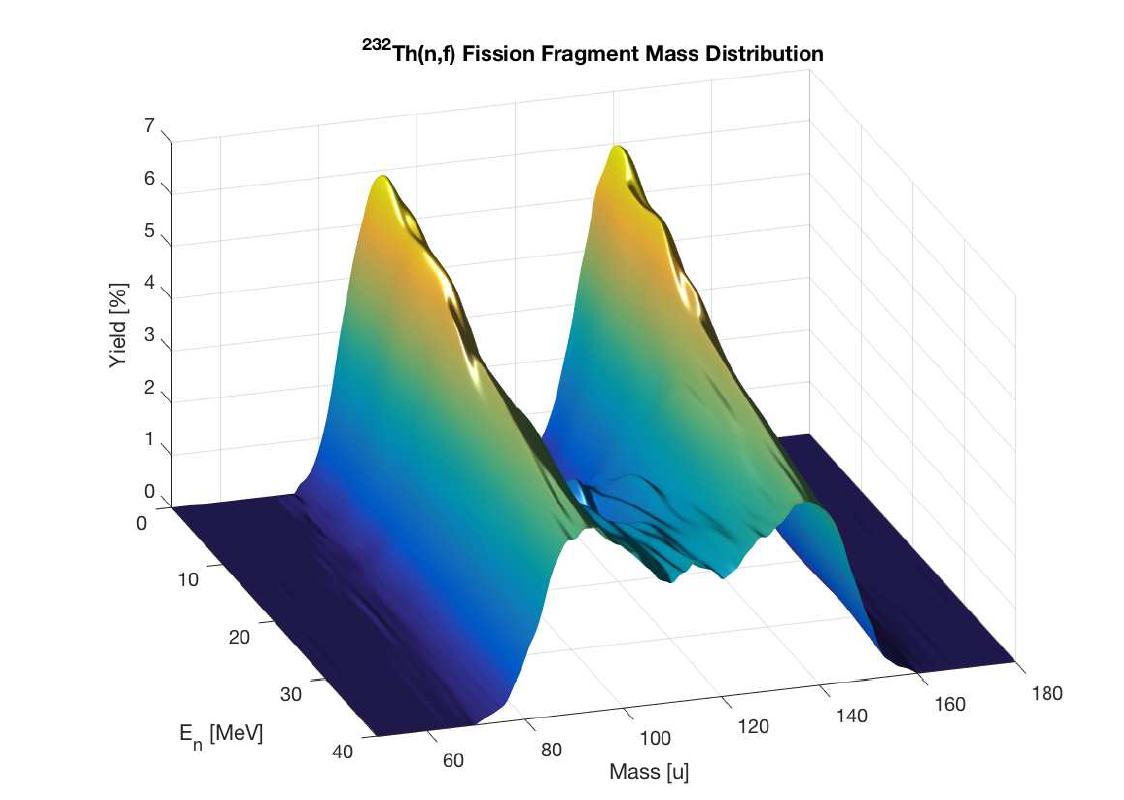
The figures above illustrate how fission fragment mass distributions evolve with incident neutron energy for neutron-induced fission of U-233. Instead of showing a single mass-yield curve, the data are presented for many neutron-energy bins and as a three-dimensional surface, where the fragment yield is plotted as a function of both fragment mass and neutron energy.
At low neutron energies, corresponding to thermal neutrons, the fission fragment mass distribution is strongly asymmetric. Two pronounced peaks appear, associated with light and heavy fission fragments. This behavior is governed by nuclear shell effects, which favor asymmetric mass splits.
As the incident neutron energy increases, the excitation energy of the fissioning nucleus increases. Nuclear shell effects gradually weaken, and the probability of symmetric fission grows. This is clearly visible in the figures as the two peaks become less distinct and the yield near symmetric masses increases.
The three-dimensional surface plot provides a continuous view of this transition. It demonstrates that fission fragment mass distributions are not fixed quantities, but evolve smoothly with neutron energy. This energy dependence becomes particularly important for fast-neutron systems, where fission occurs at MeV neutron energies rather than at thermal energies.
For nuclear reactor applications, fragment masses directly influence prompt neutron emission, decay heat, radiation damage, and fuel behavior. Therefore, nuclear data measured at thermal neutron energies cannot be directly applied to fast reactors. Reactor modeling for Generation-IV systems requires accurate, neutron-energy-dependent fission fragment mass distributions, ideally after prompt neutron emission.
Figures adapted from the PhD thesis of Daniel Higgins, “Measurement of Total Kinetic Energy and Fragment Mass Distribution in Neutron-Induced Fission of Th-232 and U-233”, reproduced for educational purposes.
Why Post-Neutron-Emission Masses Are Essential
In real reactors, fission fragments emit prompt neutrons almost immediately. What matters for reactor physics is not the initial fragment configuration, but the post-neutron-emission mass distribution. This is the quantity modern reactor models require.
From Nuclear Experiments to Reactor Data
This is exactly where experimental nuclear physics plays a key role. During my postdoctoral research, I performed such measurements at GANIL (France) using fast-neutron beams. Neutron-induced fission of actinides was studied using advanced detector systems, allowing coincidence measurements of fragment energy and velocity. From these measurements, we reconstructed fission fragment mass distributions after neutron emission and studied how these distributions evolve with incident neutron energy.
Measurement principle: Time-of-Flight and coincidence detection
To measure fission fragment mass distributions, fragments are not detected directly by their mass. Instead, their velocity and kinetic energy are measured in coincidence using a dedicated time-of-flight (TOF) spectrometer. This measurement principle is implemented in the FALSTAFF spectrometer at the Neutrons For Science (NFS) facility at GANIL.
In simple terms, measuring how fast and how energetic the fragments are allows us to reconstruct how heavy they must have been at the moment of fission.
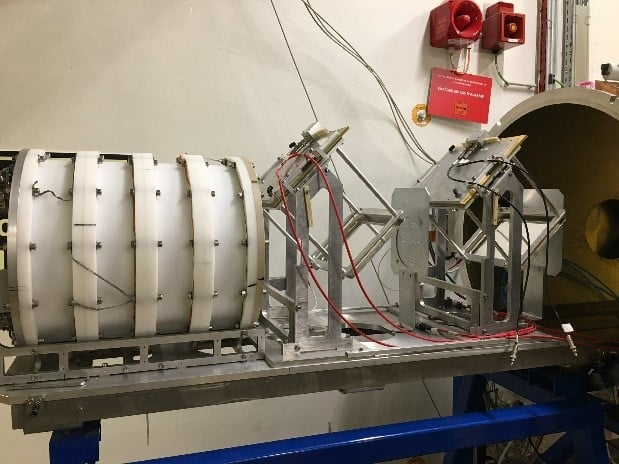
(Click the image to view the original GANIL article)
Each fission event produces two complementary fragments emitted in opposite directions. By measuring the time-of-flight over a known distance and the deposited energy in ionization chambers, the fragment velocities are determined. Using conservation of momentum and energy, the fragment masses can then be reconstructed. This coincidence technique is essential for obtaining accurate fission fragment mass distributions, particularly for fast-neutron-induced fission.
How Are These Quantities Measured?
In experiments, we do not measure masses directly. We measure time-of-flight signals, energy deposits, and detector responses. Using conservation laws, careful calibration, and detailed detector simulations, these signals are transformed into reactor-relevant nuclear data. This is the bridge between laboratory measurements and real reactor technology.
Measured → Reconstructed
- Measured: TOF, energy deposits, detector signals
- Used: calibration, conservation laws, corrections
- Output: post-neutron mass distributions for reactor models
Why This Data Matters for the Future
Accurate fast-neutron fission data enables better safety margins, more efficient use of uranium resources, recycling of nuclear waste, and reduction of long-term radiotoxicity. In simple words: next-generation nuclear reactors depend on next-generation nuclear measurements.
Conclusion
Generation-IV nuclear reactors are essential because uranium resources are limited, nuclear waste must be reduced, and sustainable energy is a global priority. Measurements of fission fragment mass distributions after neutron emission, using fast neutrons, provide the nuclear data foundation required to achieve this future.